Browse >
Home / Archive: May 2009

by St. Hilary of Poitiers
St. Hilary was the champion of the Incarnation during a time in Church history when Arianism and Orthodoxy were battling over the souls of the righteous.
The primary condition of knowledge for reading the Psalms is the ability to see as whose mouthpiece we are to regard the Psalmist as speaking, and who it is that he addresses. For they are not all of the same uniform character, but of different authorship and different types. For we constantly find that the Person of God the Father is being set before us, as in that passage of the eighty-eighth Psalm: I have exalted one chosen out of My people, I have found David My servant, with My holy oil have I anointed him. He shall call Me, You are my Father and the upholder of my salvation. And I will make him My first-born, higher than the kings of the earth ; while in what we might call the majority of Psalms the Person of the Son is introduced, as in the seventeenth: A people whom I have not known has served Me; and in the twenty-first: they parted My garments among them and cast lots upon My vesture. Read more
Fr. Jonathan Cholcher provides four measurable benchmarks for Orthodox preachers.
Orthodox preaching needs to be good preaching. To be good, Orthodox preaching must not only deliver good content, but it must strive to make the hearers good. Therefore, good Orthodox preaching is the Gospel (lit., good news) proclaimed and lived.
Four characteristics mark good Orthodox preaching:
- Christ crucified and risen;
- the language, or rationale, of Scripture;
- plain discourse; and
- attention to the experience of salvation through the Gospel.
All Orthodox preachers exhibit these traits beginning with Christ Jesus, the apostles, and the prophets. They only preach what they themselves have come to know. Read more

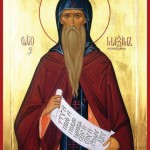
St. Maximus the Confessor
St. Maximus the Confessor was a monk and teacher, well versed in rhetoric and the classical arts. He wrote against false teachings about Christ when few would do so.
His enemies had little defense against his logic, and so rather than answer his arguments, they cut off his right hand and tore out his tongue, so that he would be able to neither preach nor write about the Truth.
Now that’s great preaching.

St. Leo the Great
St. Leo the Great was the bishop of Rome during difficult times. He was an eminent scholar of Scripture and rhetoric.
During an invasion by Attila the Hun, St. Leo met him outside the gates of Rome. After some short words, to everyone’s surprise, Attila turned and left.
Three years later, during an invasion by Genseric the Vandal, St. Leo’s intercession again saved the Eternal City from destruction.
Now that’s great preaching.

John the Baptist
St. John the Baptist was the Forerunner of our Lord Jesus Christ. We celebrate his nativity on June 24th.
He preached repentance to all, and though a celibate himself preached especially for the honor of marriage (to Herod and Herodias).
He preached for about 90 days, then was imprisoned and beheaded. You know when they want you dead after only 3 months of preaching, well…
Now that’s great preaching.

Prophet Jonah
The Prophet Jonah lived in the 8th century b.c.
Jonah preached to the people of Nineveh, and was so successful that not only did the king repent in sackcloth and ashes, but he ordered all his people to fast, and not just the people – even the cattle, in order to turn God from His righteous chastisement of the great city.
God did spare Nineveh.
Now that’s great preaching.
By: Fr. Gleb McFatter
Sermon delivered on the Sunday of Orthodox, Naples, Florida, March, 2009.
In the name of the Father, the Son, and the Holy Spirit. Amen.
This invocation of the Holy Trinity which I have just recited is familiar to us all. It is repeated often in every Orthodox service and it is included in every Orthodox prayer. Yet I wonder how many of us have ever contemplated the concept that underlies this invocation, and how that concept is the very core belief which brings us together this evening for the Triumph of Orthodoxy.
In the divine liturgy, we affirm the Holy Trinity as one in essence and undivided. In fact, the Church goes even further and confirms that the Holy Trinity is not only one in essence and undivided, but that it is also comprised of three different and distinct persons, the Father, the Son, and the Holy Spirit. Read more
Fr. Sergius Halvorsen gives some effective guidelines for sermon preparation in this article on the function of Orthodox Christian preaching.
The sermon that is preached in the context of the Divine Liturgy should lead the hearer on the path of sanctification and theosis. According to Holy Scripture, the way of sanctification and theosis is a journey that begins with the fall of our first parents in the garden, and culminates with the passion, death and resurrection of Our Lord and Savior Jesus Christ. For each one of us, our personal journey follows an identical trajectory: it begins with our personal recognition of our fallen sinful way of life, and by the Grace of God, we turn away from sin, and follow Christ to the Cross, trusting in His Power, and in the hope of His Resurrection. Baptism is the sacramental expression of this journey. It begins with exorcisms and renunciations of Satan; then we are washed clean of our sins in the water of Baptism in which we put on Christ; we are then sealed with the Gift of the Holy Spirit in Chrismation; and finally we partake of the broken body and spilled blood of Christ as a foretaste of the Kingdom of Heaven. Every time we gather as the Church to celebrate the Lord’s Supper, we retrace the fundamental life-giving journey of sanctification and theosis, which is a journey from repentance to salvation. By God’s grace we are called to turn away from sin and self-centered living, and embrace the saving way of the Cross of Jesus Christ, a journey that is made anew every time we partake of Christ’s broken body and spilled blood. This essential message of the Gospel is most perfectly summarized in the preaching of Christ, “Repent, for the Kingdom of Heaven is at hand.” (Matt 4:17) Read more
Welcome to the Preachers Institute.
The Preachers Institute is an Orthodox Christian Homiletics Resource site, which will soon be offering articles, workshops, seminars and exercises designed to assist and improve the exposition of the Gospel in the Orthodox Christian Church.
As St. Paul says,
But we preach Christ crucified; a stumbling block to the Jews, and folly to the Gentiles, but to those who are called, both Jews and Greeks, Christ the power of God and the wisdom of God.
1 Cor. 1:23-24
We are after the finest examples, articles and commentary on homiletics, and there will be some terrific material on this site shortly, contributed by some of the best teachers, preachers and homilists in the English speaking Orthodox world.
Check back soon.
We’re just getting started.
The following has been excerpted from an article by Fr. Aris Metrakos, entitled, On The Priesthood, and published in 2002 by Orthodoxytoday.org.
The more we pray, the better we preach. Why? Because it frees the Holy Spirit to guide the thoughts and words of the homilist. At the same time, preparing and delivering sermons is a skill that requires attention, perspiration, and revision. There are very few natural born preachers. Most good preachers just make it look effortless because they work hard preparing their sermons.
There are a variety of approaches to sermon preparation and delivery. Write it out and read it. Write it out and memorize it. Write it out and reduce it to an outline and use the outline when preaching. Write it out, reduce it to outline and memorize the outline. Write an outline and refer to the outline and notes as necessary in delivering the sermon. Write only an outline and commit it to memory.
It is never acceptable to show up and just start talking. This is especially true when preaching in a language that is not our mother tongue — no matter how well we think we speak that second language. Stream of consciousness worked for Hunter S. Thompson. For the rest of us, it only creates fear and loathing in the hearts of our listeners.
Preachers should record their sermons and listen to them. This helps us spot the linguistic quirks (rushing, not letting a period be a cadence, filler words such as “you know,” etc.) that keep our message from reaching the congregation.
Why all this attention to preaching? Is it to keep from being embarrassed? To look good? To gain favor? To justify a pay raise?
No. In the words of an older, much wiser priest, “When we preach, we are telling a group of people we love something that will save their lives.”
That’s why the craft of homiletics deserves so much attention.
Next Page »