St. Paul – Apostle to the Gentiles

June 29, 2009 by: admin  
Filed under: Great Preachers

Print Print   Email Email

stpaul150x150

St. Paul

He was a student of Rabbi Gamaliel, and converted by the direct revelation of Jesus Christ, on the road to Damascus.

Paul’s preaching often either converted his listeners or left them enraged, and they often had him stoned, beaten with rods, flogged, imprisoned and falsely accused. When he reached the end of his earthly journey, he was beheaded in Rome – according to Tradition, on the same day St. Peter was crucified.

Now that’s great preaching!

Metropolitan Jonah to ACNA

June 29, 2009 by: admin  
Filed under: Video Sermons

Print Print   Email Email

This speech contains many of the elements of the classic Orthodox Christian sermon.

Metropolitan Jonah, primate of the Orthodox Church in America, preaches a word of humility, love, repentance, and “with open arms” calls out to the members of the Anglican Church of North America at their recent convention.

You can comment on it in the forum.

St. Peter – Prince of the Apostles

June 24, 2009 by: admin  
Filed under: Great Preachers

Print Print   Email Email

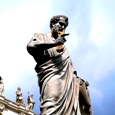
stpeterkeys big

St. Peter

He was a fisherman, and Jesus’ premier apostle during His earthly ministry, and after the Ascension. To him, Christ gave the Keys to the Kingdom of Heaven. He preached in Jerusalem, converting over 3,000 souls on Pentecost. He also preached in Antioch and Rome. For his evangelistic successes in Rome, he was crucified upside down in a.d. 64.

Now that’s great preaching!

Homily 1 – Against Those Who Say Demons Govern Human Affairs

June 23, 2009 by: admin  
Filed under: Great Preachers, Patristics

Print Print   Email Email

chrysostomhead115x115By St. John Chrysostom

The mighty preacher, St. John, Archbishop of Constantinople, provides an excellent example of his homiletic prowess in this sermon – as poignant today as it was then in the 4th century. It is easy to see why St. John is the patron saint of preachers.

Against those who say that demons govern human affairs, and who are displeased at the chastisement of God, and are offended by the prosperity of the wicked and the hardships of the Just.

I indeed was hoping, that from the continuance of my discourse, you would have had a surfeit of my words: but I see that the contrary is happening: that no surfeit is taking place from this continuance, but that your desire is increased, that an addition is made not to your satiety but to your pleasure, that the same thing is happening which the wine drinkers at heathen drinking-bouts experience; for they, the more they pour down unmixed wine, so much the rather they kindle their thirst, and in your case the more teaching we inculcate, so much the rather do we kindle your desire, we make your longing greater, your love for it the stronger. Read more

Sermon 1 on the New Testament

June 22, 2009 by: admin  
Filed under: Patristics

Print Print   Email Email

augustine2By St. Augustine of Hippo

The first of many sermons on the New Testament by the blessed bishop of Hippo, this sermon displays Augustine’s keen intellect and attention to details in Scripture, in this case, answering questions regarding the genealogies in the Gospels according to Matthew and Luke.

Of the agreement of the evangelists Matthew and Luke in the generations of the Lord.

May He, beloved, fulfill your expectation who has awakened it: for though I feel confident that what I have to say is not my own, but God’s, yet with far more reason do I say, what the Apostle in his humility says, “We have this treasure in earthen vessels, that the excellency of the power may be of God, and not of us.” Read more

The Pastoral Rule: On Those Who Preach

June 16, 2009 by: admin  
Filed under: Patristics

Print Print   Email Email

Gregorius115

by St. Gregory the Great, the Pope of Rome.

Among works of inestimable influence in the history of the Church, few approach the impact of St. Gregory’s “Regulae Pastoralis,” or “Pastoral Rule.” Written to John, Bishop of Ravenna, it was as influential to the guidance  of secular clergy and growth of the Church in the west as the famous ‘Rule of St. Benedict’ was to western monasticism, if not more.

For several hundred years, it was required reading for all clergy, and frequent references to it were made during the synod meetings of bishops. Here is the section of Book III, dealing with those who preach.

How those are to be admonished who decline the office of preaching out of too great humility, and those who seize on it with precipitate haste.

Those who are able to preach worthily, but who are afraid by reason of excessive humility are to be admonished one way, and in another, those whom unfitness or age forbids to preach, and yet hastiness impells. Read more

Sermons and Snickers Bars

June 12, 2009 by: admin  
Filed under: Featured, Peck, John A. Fr., Sermon Resources

Print Print   Email Email

by Fr. John A. Peck

This little article recounts an important object lesson, given at a St. Herman Seminary homiletics class in 1996.

I attended St. Herman Seminary in Kodiak, Alaska. At that distant outpost of theological instruction, we took homiletics very seriously, as we knew that on any given day or week, we might be called upon to travel to a local village and provide not only readers’ services, but a basic homily. We also knew that the bishop delighted in calling on clergy and students, spur of the moment, to preach from the Gospel reading of the day. We knew we had to be ready.

My favorite class was the “Snickers bar” lecture, as it became known. Read more

First Theological Oration (Oration 27)

June 12, 2009 by: admin  
Filed under: Patristics

Print Print   Email Email

Light115

By St. Gregory Nazianzus (the Theologian)

In this, St. Gregory’s first theological oration, we have an excellent apologetic use of reason and Holy Scripture, in an initial refutation of the Eunomians, who sought to defend the fullest errors of Arianism on the basis of Aristotelean dialectics following the First Council of Nicea.

I am to speak against persons who pride themselves on their eloquence; so, to begin with a text of Scripture, “Behold, I am against you, O proud one,” (Jer. 50:31) not only in your system of teaching, but also in your hearing, and in your tone of mind. For there are certain persons who have not only their ears (2 Tim. 4:3) and their tongues, but even, as I now perceive, their hands too, itching for our words; who delight in profane babblings, and oppositions of science falsely so called, and strife about words, which tend to no profit; for so Paul, the Preacher and Establisher of the “Word cut short,” (Rom. 9:28) the disciple and teacher of the Fishermen, calls all that is excessive or superfluous in discourse. Read more

Brother, Can You Spare A Paradigm?

June 10, 2009 by: admin  
Filed under: Featured, Metrakos, Aris Fr., Sermon Resources

Print Print   Email Email

by Fr. Aris Metrakos

This essay was first published June 30, 2006 on Orthodoxytoday.org, and not only uncovers the dangers of old paradigms of priestly identity, but also reveals the only one of value in the Church. We reproduce it here with permission.

Is it time to retire “paradigm shift?”

This overwrought cliché is used to describe everything from new laundry soap to the wireless mouse. Even worse, religious types have taken a liking to it. Clergy and lay leaders are convinced if they could just figure out how to shift their paradigm, the pews and offering trays would overflow. (Do we really need to sit through one more mission statement formulation?) Read more

The Troublesome Nature of Apologetics: Part 2

June 10, 2009 by: admin  
Filed under: Apologetics, Reardon, Patrick Fr.

Print Print   Email Email

A continuation of last week’s Pastoral Pondering on Apologetics,  for Sunday, June 21 2009.

I have suggested that the discipline of apologetics, the reasoned defense of the Christian faith, is sometimes troublesome to the pursuit of theology. It seems to me that the history of soteriology, the theology of salvation, manifests a singular case in point.

When it starts from apologetics, soteriology is somewhat compelled to commence outside itself, to begin with the state of not-being-saved. Apologetics obliges soteriology to inquire, “From what are we saved?” The answer, of course, is “sin.” Read more

Next Page »