Sermon on the Feast of Pentecost
May 20, 2010 by Fr. John A. Peck
Filed under Patristics, Sermons on Pentecost
Comments Off
by St. John Chrysostom
Our father among the saints John Chrysostom, Archbishop of Constantinople, was a notable Christian bishop and preacher from the fourth and fifth centuries in Syria and Constantinople. He is famous for eloquence in public speaking and his denunciation of abuse of authority in the Church and in the Roman Empire of the time. His banishments demonstrated that secular powers had strong influence in the eastern Church at this period in history.
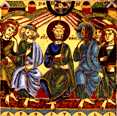
Let us spiritually extol the grace of the Holy Spirit in spiritual hymns, since spiritual grace has on this day shown upon us from heaven. Though our words are too weak to express adequately the greatness of this grace, we shall praise its power and activity to the extent of our abilities; for the Holy Spirit probes all things, even the depths of divinity. Read more
The Sermon and the Chalice: Part Two
March 27, 2010 by Fr. John A. Peck
Filed under Sermon Resources, Steenberg, M. C. Prof.
Comments Off
This is part two of a two part article by Prof. Steenberg is based on a talk originally given in November 2007 at Ampleforth Abbey, Yorkshire, United Kingdom, as part of a day conference on St John Chrysostom during the year commemorating the 1,600th anniversary of the saint’s repose.
The homily, the Word, and the Spirit
The particular connection to be made in the above, in terms of understanding St John Chrysostom as homilist, is that of the homily as the means of bringing about communion—of opening up the heart, in the Spirit, to the eternal Word of the Father—with the Eucharistic celebration as the mystery of this communion perfected. That at which the homily aims, is experienced fully in the Eucharist.
To this end, the relationship of the homily to the communion feast is of the most intimate sort. The sermon is not an extra component or a ‘learning segment’ in an otherwise liturgical act: it is itself intrinsically liturgical, inasmuch as it constitutes an ascetical tool bringing the faithful to the encounter at the chalice. This may be overtly obvious in St John’s Paschal homily (‘The table is full-laden; feast ye all sumptuously […] receive ye all the riches of loving-kindness’), but it is no less true in his homiletic works taken as a whole. The homily, rightly employed in the ministry of the Church, is a means of ascesis, of conditioning, that prepares the heart to receive the Word in the sacrament. Read more
The Sermon and the Chalice: Part One
March 26, 2010 by Fr. John A. Peck
Filed under Featured, Sermon Resources, Steenberg, M. C. Prof.
Comments Off
At the request of some of our readers, we are again making this article, which links the importance of the Sermon with the Holy Eucharist, available at Preachers Institute. This two part article by Prof. Steenberg is based on a talk originally given in November 2007 at Ampleforth Abbey, Yorkshire, United Kingdom, as part of a day conference on St John Chrysostom during the year commemorating the 1,600th anniversary of the saint’s repose.
St John Chrysostom on receiving the Word of God
In undoubtedly his most well-known homily, read in every Orthodox church at the matins of Pascha, St John Chrysostom proclaims:
Enter ye all into the joy of your Lord;
Receive your reward,
Both the first, and likewise the second.
You rich and poor together, hold high festival!
You sober and you heedless, honour the day!
Rejoice today, both you who have fasted
And you who have disregarded the fast.
The table is full-laden; feast ye all sumptuously.
The calf is fatted; let no one go hungry away.
Enjoy ye all the feast of faith:
Receive ye all the riches of loving-kindness.
It is an exuberant text, a capstone of Paschal reflection, and a shining example of patristic homiletics. Read more
Homily 1 – Against Those Who Say Demons Govern Human Affairs
June 23, 2009 by Fr. John A. Peck
Filed under Great Preachers, Patristics
Comments Off
By St. John Chrysostom
The mighty preacher, St. John, Archbishop of Constantinople, provides an excellent example of his homiletic prowess in this sermon – as poignant today as it was then in the 4th century. It is easy to see why St. John is the patron saint of preachers.
Against those who say that demons govern human affairs, and who are displeased at the chastisement of God, and are offended by the prosperity of the wicked and the hardships of the Just.
I indeed was hoping, that from the continuance of my discourse, you would have had a surfeit of my words: but I see that the contrary is happening: that no surfeit is taking place from this continuance, but that your desire is increased, that an addition is made not to your satiety but to your pleasure, that the same thing is happening which the wine drinkers at heathen drinking-bouts experience; for they, the more they pour down unmixed wine, so much the rather they kindle their thirst, and in your case the more teaching we inculcate, so much the rather do we kindle your desire, we make your longing greater, your love for it the stronger. Read more
The Homilist
May 15, 2009 by Fr. John A. Peck
Filed under Peck, John A. Fr.
Comments Off
Homiletics in theology the application of the general principles of rhetoric to the specific work of public preaching.
The one who practices or studies homiletics is called a homilist.
Homiletics (Greek homiletikos, from homilos, to assemble together), is one of those disciplines which is easy to do, but difficult to do well. The terms homily and sermon are often used interchangeably (see the glossary for an exacting definition). The art of homiletics is not to be undertaken lightly or casually, but with much prayer, and not a little fasting.
The crafting of the homily is a lot like writing a song. There are millions of songs out there, and more being written every day, but few being sung. Few touch a chord within the listener. Few get inside, so to speak. The turn of the phrase is not extemporaneous, but exacting. The measure of language, inflection, delivery and even diction should be prayerfully considered. It is an awesome and fearful thing to stand in the fire.
How much more to deliver it? Read more