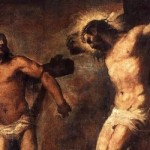
Why The Good Thief Was Pardoned

April 2, 2010 by Fr. John A. Peck  
Filed under Featured, Patristics

Comments Off

by St. John Maximovitch

Our father among the saints, John Maximovitch, was a diocesan bishop of the Russian Orthodox Church Outside Russia (ROCOR) who served widely from China to France to the United States.

Countless miracles have been attributed to this holy bishop, both during his lifetime and since his repose.

And one of the malefactors which were hanging railed on Him, saying, If thou be Christ, save thyself and us. But the other rebuked him, saying, Dost thou not fear God, seeing thou art in the same condemnation? And we indeed justly; for we receive the due reward of our deeds: but this man hath done nothing amiss. And he said unto Jesus, Lord, remember me when Thou contest into Thy kingdom. And Jesus said unto him, Verily I say unto thee, Today shalt thou be with Me in paradise. (Luke 23:39-13)

This Is How the holy Evangelist Luke relates the edifying and moving incident concerning the conversion and the Lord’s pardoning of the thief who hung on the cross next to Him on Golgotha. Read more

Epiphany Homily by St. Jerome of Stridonium

January 3, 2010 by Fr. John A. Peck  
Filed under Featured, Patristics, Sermons on Theophany

Comments Off


Our venerable and God-bearing father Jerome was noted as a scholar of Latin at the time when Greek was considered the language of scholarship. He was one of the most learned of the Fathers of the Western Church and is noted as the translator of the holy scriptures into Latin. This translation, the Vulgate, became the official biblical text of the Roman Catholic Church. A critic of secular excesses, he was a strong defender of the Orthodox faith against the heresies of his time.

The Feast of the Epiphany is called by its Greek name epipháneia, which is the Greek expression for our concept of appearance, or manifestation. This, therefore, is the title given to our Lord and Savior’s manifestation on earth.

Even though He had been born of Mary and had already completed thirty years of His life, nevertheless, He was unknown to the world. His identity was revealed at the time when He came to the Jordan to be baptized by John the Baptist, and the voice of the Father was heard thundering from heaven:

This is my beloved Son, in whom I am well pleased (Mt 3:17).

The Father had proclaimed Him by His voice from the heavens, and the Holy Spirit, settling upon His head in the form of a dove, ordained to make Him known by that revelation, lest people mistake anyone else for the Son of God. What is more sublime than His humility, more noble than His belittlement?

He is baptized by His servant and He is named Son by God.

Along the publicans, prostitutes, and sinners, He came for baptism, and He is holier than the one who baptizes.

He is purified by John in the flesh, but He purifies John in the spirit.

The waters that had been wont to cleanse others are now purified by the cleansing of our Lord. The Jordan river that dried up when Joshua led the Israelites into the Land of Promise, now longed to gather together all its waters into one place, if it could, to bathe the body of the Lord.

Plotting The Course

Comments Off

Fr. Sergius Halvorsen gives some effective guidelines for sermon preparation in this article on the function of Orthodox Christian preaching.

The sermon that is preached in the context of the Divine Liturgy should lead the hearer on the path of sanctification and theosis. According to Holy Scripture, the way of sanctification and theosis is a journey that begins with the fall of our first parents in the garden, and culminates with the passion, death and resurrection of Our Lord and Savior Jesus Christ. For each one of us, our personal journey follows an identical trajectory: it begins with our personal recognition of our fallen sinful way of life, and by the Grace of God, we turn away from sin, and follow Christ to the Cross, trusting in His Power, and in the hope of His Resurrection. Baptism is the sacramental expression of this journey. It begins with exorcisms and renunciations of Satan; then we are washed clean of our sins in the water of Baptism in which we put on Christ; we are then sealed with the Gift of the Holy Spirit in Chrismation; and finally we partake of the broken body and spilled blood of Christ as a foretaste of the Kingdom of Heaven. Every time we gather as the Church to celebrate the Lord’s Supper, we retrace the fundamental life-giving journey of sanctification and theosis, which is a journey from repentance to salvation. By God’s grace we are called to turn away from sin and self-centered living, and embrace the saving way of the Cross of Jesus Christ, a journey that is made anew every time we partake of Christ’s broken body and spilled blood. This essential message of the Gospel is most perfectly summarized in the preaching of Christ, “Repent, for the Kingdom of Heaven is at hand.” (Matt 4:17) Read more