On Doubting Thomas
April 7, 2010 by Fr. John A. Peck
Filed under Paschal Sermons, Patristics
Comments Off
by St. Gregory the Great
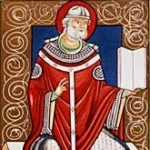
Our father among the saints Gregory I, also known as Gregory the Great, was the Pope of Rome from September 3, 590, until his death on March 12, 604.
He is noted for his writings.
Also, the Liturgy of the Presanctified Gifts has been attributed to him.
The following is an excerpt from the homilies of St. Gregory the Great (also known as “St. Gregory the Dialogist”). In both East and West, the Sunday after Easter (Pascha) is devoted to “the beautiful unbelief of Thomas,” whose doubt stands as a proxy, making our own unnecessary:
Thomas, one of the twelve, called the Twin, was not with them when Jesus came. He was the only disciple absent; on his return he heard what had happened but refused to believe it. The Lord came a second time; He offered His side for the disbelieving disciple to touch, held out His hands, and showing the scars of His wounds, healed the wound of his disbelief. Read more
The Mystery Of The Resurrection
March 12, 2010 by Fr. John A. Peck
Filed under Patristics
Comments Off
by St. Gregory the Great
Our father among the saints Gregory I, also known as Gregory the Great, was the Pope of Rome from September 3, 590, until his death on March 12, 604. He is noted for his writings.
Also, the Liturgy of the Presanctified Gifts has been attributed to him.
Given to the People in the Basilica of the Blessed Virgin Mary, on the Holy Day of the Resurrection
1. It has been my custom, beloved brethren, to speak to you on many of the Gospel readings, by means of a sermon I had already dictated for you. But since I have been unable, because of the weakness of my throat, to read to you myself what I had prepared, I notice that some among you listen somewhat indifferently. So, contrary to my usual practice, I shall for the future make the effort during the sacred solemnities of the Mass to explain the Gospel, not through a sermon I have dictated, but by speaking directly to you myself. Read more
The Lord Follows His Preachers
January 9, 2010 by Fr. John A. Peck
Filed under Patristics
Comments Off
by St. Gregory the Great, The Dialogist
Our father among the saints Gregory I, also known as Gregory the Dialogist, was the Pope of Rome until his death in 604 AD. He is certainly one of the most notable figures in Ecclesiastical History. He has exercised in many respects a momentous influence on the doctrine, the organization, and the discipline of the Church. To him we must look for an explanation of the religious situation of the Middle Ages.
Indeed, if no account were taken of his work, the evolution of the form of medieval Christianity would be almost inexplicable. He is noted for his writings. The Liturgy of the Presanctified Gifts, rich with Scriptural quotations and imagery, has been associated to him as its author.
Beloved brothers, our Lord and Savior sometimes gives us instruction by words and sometimes by actions. His very deeds are our commands; and whenever he acts silently he is teaching us what we should do. For example, he sends his disciples out to preach two by two, because the precept of charity is twofold – love of God and of one’s neighbor.
The Lord sends his disciples out to preach in twos in order to teach us silently that whoever fails in charity toward his neighbor should by no means take upon himself the office of preaching. Rightly is it said that he sent them ahead of him into every city and place where he himself was to go. For the Lord follows after the preachers, because preaching goes ahead to prepare the way, and then when the words of exhortation have gone ahead and established truth in our minds, the Lord comes to live within us.
To those who preach Isaiah says:
Prepare the way of the Lord, make straight the paths of our God.
And the psalmist tells them:
Make a way for him who rises above the sunset.
The Lord rises above the sunset because from that very place where he slept in death, he rose again and manifested a greater glory. He rises above the sunset because in his resurrection he trampled underfoot the death which he endured. Therefore, we make a way for him who rises above the sunset when we preach his glory to you, so that when he himself follows after us, he may illumine you with his love.
Let us listen now to his words as he sends his preachers forth:
The harvest is great but the laborers are few. Pray therefore the Lord of the harvest to send laborers into his harvest.
That the harvest is good but the laborers are few cannot be said without a heavy heart, for although there are many to hear the good news there are only a few to preach it. Indeed, see how full the world is of priests, but yet in God’s harvest a true laborer is rarely to be found; although we have accepted the priestly office we do not fulfill its demands.
Think over, my beloved brothers, think over his words:
Pray the Lord of the harvest to send laborers into his harvest.
Pray for us so that we may be able to labor worthily on your behalf, that our tongue may not grow weary of exhortation, that after we have taken up the office of preaching our silence may not bring us condemnation from the just judge.
A Christmas Sermon of St. Gregory the Great
December 20, 2009 by Fr. John A. Peck
Filed under Featured, Patristics, Sermons on Nativity
Comments Off
Given to the People in the Basilica of the Blessed Virgin Mary on the day of the Nativity of Our Lord.
Our father among the saints Gregory I, also known as Gregory the Dialogist, was the Pope of Rome from September 3, 590, until his death on March 12, 604. He is certainly one of the most notable figures in Ecclesiastical History. He has exercised in many respects a momentous influence on the doctrine, the organization, and the discipline of the Church. To him we must look for an explanation of the religious situation of the Middle Ages.
Indeed, if no account were taken of his work, the evolution of the form of medieval Christianity would be almost inexplicable. He is noted for his writings. The Liturgy of the Presanctified Gifts, rich with Scriptural quotations and imagery, has been associated to him as its author.
Because by the Divine Bounty we are on this day thrice to celebrate the sacred mysteries of the Liturgy, we cannot therefore speak at length on the Gospel lesson. But the Birth of Our Redeemer Himself demands of us that we say something for the occasion, however briefly. Read more