Happy Theophany!
January 6, 2010 by Fr. John A. Peck
Filed under Peck, John A. Fr.
Comments Off
Happy Feast Day everyone!
Christ is baptized in the Jordan!
And we with Him!
At the completion of the twelve-day festival, starting on December 25, and ending on January 5, known as Christmastide or the twelve days of Christmas, (although some Christian cultures, especially those of Latin America and some in Europe extend it to as many as forty days, ending on Candlemas – February 2).
It goes by other names in various church traditions. In Hispanic and Latin culture, as well as some places in Europe, it is known as Three Kings’ Day (Span: el Dia de los Tres Reyes, la Fiesta de Reyes, or el Dia de los Reyes Magos; Dutch: Driekoningendag). Originally, there was just one Christian feast of the shining forth of God to the world in the human form of Jesus of Nazareth. It included the celebration of Christ’s birth, the adoration of the Wisemen, and all of the childhood events of Christ such as his circumcision and presentation to the temple as well as his baptism by John in the Jordan. There seems to be little doubt that this feast, like Pascha and Pentecost, was understood as the fulfillment of a previous Jewish festival, in this case the Feast of Lights.
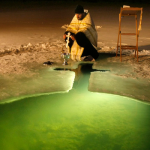
In the Orthodox Church, this observance commemorates Christ’s baptism by John the Forerunner in the River Jordan, and the beginning of Christ’s earthly ministry. The Feast of Theophany is the culmination of the Christmas Season, which starts on December 25 and ends on January 6. In mystic commemoration of this event, the Great Blessing of Water is performed on this day, and the holy water so blessed is used by the local priest to bless the homes of the faithful.
Epiphany
This feast is also sometimes referred to as Epiphany by English-speaking Orthodox Christians, but that name more properly refers to the Western Christian feast falling on that same day and commemorating the visit of the Magi to the child Jesus. The term “Epiphany” does appear in the services for this feast, however.
Celebration of the feast
The services of Theophany are set up exactly as those of the Nativity. Historically the Christmas services were established later.
The Royal Hours are read and the Divine Liturgy of St. Basil the Great is served with Vespers on the eve of the feast. The Vigil is made up of Great Compline and Matins
The Liturgy of the feast begins with psalms of glorification and praise instead of the three normal Antiphons. And the baptismal line from Galatians 3:27 once again replaces the Thrice-Holy.
For as many as been baptized into Christ, have put on Christ! Alleluia!
The Gospel readings of all the services tell of the Lord’s baptism by John in the Jordan River. The epistle reading of the Divine Liturgy tells of the consequences of the Lord’s appearing which is the divine epiphany.
Since the main feature of the feast is the blessing of water. It is prescribed to follow both the Divine Liturgy of the eve of the feast and the Divine Liturgy of the day itself. But most local parishes do it only once when most of the parishioners can be present. The blessing verifies that mankind, and all of creation, were created to be filled with the sanctifying presence of God.
On the Feast of Theophany itself, the priest, wearing white vestments, will celebrate the Great Blessing of Waters, and in some regions frankincense, gold, and chalk.
The blessed chalk is used to write the initials of the three magi over the doors of churches and homes.
Not only do the letters stand for the initials of the Magi (traditionally named Caspar, Melchior, and Balthasar), but of the phrase Christus mansionem benedicat, which translates as
“may Christ bless the house.”
In Alaska, candles are used instead to mark the threshold of every doorway with the sign of the cross.
May Christ bless your home during this holy season, and on this glorious day!
On The Holy Lights – Part 2
January 5, 2010 by Fr. John A. Peck
Filed under Patristics, Sermons on Theophany
Comments Off
by St. Gregory Nazianzus “the Theologian”
Our father among the saints Gregory the Theologian , also known as Gregory of Nazianzus (though that name more appropriately refers to his father) and Gregory the Younger, was a great Father and Teacher of the Church. He was a close friend of St. Basil the Great. He was one of the great Cappodocean Fathers, and is one of only three saints given the title “Theologian” in all of Orthodox hagiography and theology.
XI. And now, having purified the theater by what has been said, let us discourse a little about the Festival, and join in celebrating this Feast with festal and pious souls. And, since the chief point of the Festival is the remembrance of God, let us call God to mind. For I think that the sound of those who keep Festival There, where is the dwelling of all the Blissful, is nothing else than this, the hymns and praises of God, sung by all who are counted worthy of that City. Let none be astonished if what I have to say contains some things that I have said before; for not only will I utter the same words, but I shall speak of the same subjects, trembling both in tongue and mind and thought when I speak of God for you too, that you may share this laudable and blessed feeling. Read more
On The Holy Lights – Part 1
January 5, 2010 by Fr. John A. Peck
Filed under Patristics, Sermons on Theophany
Comments Off
by St. Gregory Nazianzus “the Theologian”
Our father among the saints Gregory the Theologian , also known as Gregory of Nazianzus (though that name more appropriately refers to his father) and Gregory the Younger, was a great Father and Teacher of the Church. He was a close friend of St. Basil the Great. He was one of the great Cappodocean Fathers, and is one of only three saints given the title “Theologian” in all of Orthodox hagiography and theology.
I. Again My Jesus, and again a mystery; not deceitful nor disorderly, nor belonging to Greek error or drunkenness (for so I call their solemnities, and so I think will every man of sound sense); but a mystery lofty and divine, and allied to the Glory above.
For the Holy Day of the Lights (Theophany), to which we have come, and which we are celebrating today, has for its origin the Baptism of my Christ, the True Light That lightens every man that comes into the world, and effects my purification, and assists that light which we received from the beginning from Him from above, but which we darkened and confused by sin. Read more
Sermon 36 On The Feast of Epiphany
January 5, 2010 by Fr. John A. Peck
Filed under Patristics, Sermons on Theophany
Comments Off
by St. Leo the Great
Our father among the saints, Leo the Great was the bishop of Rome during difficult times. He was an eminent scholar of Scripture and rhetoric. During an invasion by Attila the Hun, St. Leo met him outside the gates of Rome. After some short words, to everyone’s surprise, Attila turned and left. Three years later, during an invasion by Genseric the Vandal, St. Leo’s intercession again saved the Eternal City from destruction.
I. The story of the magi not only a bygone fact in history, but of everyday application to ourselves
The day, dearly-beloved, on which Christ the Savior of the world first appeared to the nations must be venerated by us with holy worship: and today those joys must be entertained in our hearts which existed in the breasts of the three magi, when, aroused by the sign and leading of a new star, which they believed to have been promised, they fell down in presence of the King of heaven and earth. Read more
Discourse On The Holy Theophany
January 4, 2010 by Fr. John A. Peck
Filed under Featured, Patristics, Sermons on Theophany
Comments Off
by St. Hippolytus of Rome
Our father Hippolytus was one of the most prolific writers of the early Church, and was distinguished by his learning and eloquence. He was born in Rome in the mid-100s, and Origen of Alexandria, while still a young man, heard him preach. St. Photius describes him in his Bibliotheca (cod. 121) as a disciple of St. Irenaeus of Lyons, who was himself a disciple of St. Polycarp of Smyrna. He died a martyr, being dragged to death by wild horses at Ostia.
1. Good, yea, very good, are all the works of our God and Savior— all of them that eye sees and mind perceives, all that reason interprets and hand handles, all that intellect comprehends and human nature understands. For what richer beauty can there be than that of the circle of heaven?
And what form of more blooming fairness than that of earth’s surface? And what is there swifter in the course than the chariot of the sun? And what more graceful car than the lunar orb? And what work more wonderful than the compact mosaic of the stars? And what more productive of supplies than the seasonable winds? And what more spotless mirror than the light of day? And what creature more excellent than man? Read more
A Sermon On The Day Of Theophany
January 3, 2010 by Fr. John A. Peck
Filed under Patristics, Sermons on Theophany
Comments Off
Our father among the saints John Maximovitch, Archbishop of Shanghai and San Francisco – The Wonderworker (d. 1966), was a diocesan bishop of the Russian Orthodox Church Outside Russia (ROCOR) who served widely from China to France to the United States. Countless miracles have been attributed to this holy bishop, both during his lifetime and since his repose. He guided souls in many places across the globe during his earthly sojourn.
Today the nature of the waters is sanctified. Today the Son of God is baptized in the waters of the Jordan, having no need Himself of cleansing, but in order to cleanse the sinful human race from defilement.
Now the heavens open and the voice of God the Father is heard: This is My beloved Son. The Holy Spirit descends upon the Savior of the world, Who stands in the Jordan, thereby confirming that this indeed is He Who is the incarnate Son of God. The Holy Trinity is clearly made manifest and is revealed to mankind. Read more
Sermon 34 On The Feast Of Epiphany
January 3, 2010 by Fr. John A. Peck
Filed under Featured, Patristics, Sermons on Theophany
Comments Off
by St. Leo the Great
Our father among the saints, Leo the Great was the bishop of Rome during difficult times. He was an eminent scholar of Scripture and rhetoric. During an invasion by Attila the Hun, St. Leo met him outside the gates of Rome. After some short words, to everyone’s surprise, Attila turned and left. Three years later, during an invasion by Genseric the Vandal, St. Leo’s intercession again saved the Eternal City from destruction.
The yearly observance of the Epiphany is profitable to Christians
It is the right and reasonable duty of true piety, dearly-beloved, on the days which bear witness to the works of Divine mercy, to rejoice with the whole heart and to celebrate with all honor the things which have been wrought for our salvation: for the very law of recurring seasons calls us to such devout observance, and has now brought before us the feast of the Epiphany, consecrated by the Lord’s appearance soon after the day on which the Son of God co-eternal with the Father was born of a Virgin. And herein the providence of God has established a great safeguard to our faith, so that, while the worship of the Savior’s earliest infancy is repeated year by year, the production of true man’s nature in Him might be proved by the original verifications themselves. For this it is that justifies the ungodly, this it is that makes sinners saints, to wit the belief in the true Godhead and the true Manhood of the one Jesus Christ, our Lord: the Godhead, whereby being before all ages “in the form of God” He is equal with the Father: the Manhood whereby in the last days He is united to Man in the “form of a slave.” Read more
On the Day of Christ’s Baptism – Part 2
January 2, 2010 by Fr. John A. Peck
Filed under Patristics, Sermons on Theophany
Comments Off
by St. John Chrysostom
Our father among the saints John Chrysostom, Archbishop of Constantinople, was a notable Christian bishop and preacher from the fourth and fifth centuries in Syria and Constantinople. He is famous for eloquence in public speaking and his denunciation of abuse of authority in the Church and in the Roman Empire of the time. His banishments demonstrated that secular powers had strong influence in the eastern Church at this period in history.
Call to mind that day, on which for the Apostles
“there appeared disparate tongues like fire, and sat over each one of them” (Acts 2:3).
And that the baptism of John did not impart the Spirit and remission of sins is evident from the following: Paul
“found certain disciples, and said to them: received ye the Holy Spirit since ye have believed? They said to him: but furthermore whether it be of the Holy Spirit, we shall hear. He said to them: into what were ye baptized? They answered: into the baptism of John. Paul then said: John indeed baptized with the baptism of repentance,” — repentance, but not remission of sins; for whom did he baptize? “Having proclaimed to the people, that they should believe in the One coming after him, namely, Christ Jesus. Having heard this, they were baptized in the Name of the Lord Jesus: and Paul laying his hands on them, the Holy Spirit came upon them” (Acts 19:1-6).
Do you see, how incomplete was the baptism of John? If the one were not incomplete, would then Paul have baptized them again, and placed his hands on them; having performed also the second, he shew the superiority of the apostolic Baptism and that the baptism of John was far less than his. Thus, from this we recognize the difference of the baptisms. Read more
On the Day of Christ’s Baptism – Part 1
January 1, 2010 by Fr. John A. Peck
Filed under Featured, Patristics, Sermons on Theophany
Comments Off
by St. John Chrysostom
Our father among the saints John Chrysostom, Archbishop of Constantinople, was a notable Christian bishop and preacher from the fourth and fifth centuries in Syria and Constantinople. He is famous for eloquence in public speaking and his denunciation of abuse of authority in the Church and in the Roman Empire of the time. His banishments demonstrated that secular powers had strong influence in the eastern Church at this period in history.
We shall now say something about the present feast. Many celebrate the feast days and know their designations, but the cause for which they were established they know not. Thus concerning this, that the present feast is called Theophany — everyone knows; but what this is — Theophany, and whether it be one thing or another, they know not. And this is shameful — every year to celebrate the feast day and not know its reason. Read more
A Sermon for the Theophany
December 31, 2009 by Fr. John A. Peck
Filed under Featured, Patristics, Sermons on Theophany
Comments Off
by St. Gregory of Nyssa
Our father among the saints Gregory of Nyssa was bishop of Nyssa and a prominent theologian of the fourth century. He was the younger brother of Basil the Great and friend of Gregory the Theologian. He is one of the “Cappadocian Fathers,” a title which reveals at once his birthplace in Asia Minor and the magnitude of his intellect. He is commemorated on January 10.
Now I recognize my own flock: today I behold the wonted figure of the Church, when, turning with aversion from the occupation even of the cares of the flesh, you come together in your undiminished numbers for the service of God— when the people crowds the house, coming within the sacred sanctuary, and when the multitude that can find no place within fills the space outside in the precincts like bees. For of them some are at their labors within, while others outside hum around the hive.
So do, my children: and never abandon this zeal. For I confess that I feel a shepherd’s affections, and I wish, when I am set upon this watchtower, to see the flock gathered round about the mountain’s foot: and when it so happens to me, I am filled with wonderful earnestness, and work with pleasure at my sermon, as the shepherds do at their rustic strains. Read more