On The Veneration Of The Precious Cross
February 28, 2010 by: admin
Filed under: Featured, Patristics, Sermons on the Cross
by St. John Maximovitch
Our father among the saints, John Maximovitch, was a diocesan bishop of the Russian Orthodox Church Outside Russia (ROCOR) who served widely from China to France to the United States. Countless miracles have been attributed to this holy bishop, both during his lifetime and since his repose. During this year, we will be offering some of his Pre-Lenten and Lenten themed sermons for your reference. Read them reverently.
Before the time of Christ, the cross was an instrument of punishment; it evoked fear and aversion. But after Christ’s death on the Cross it became the instrument of our salvation. Through the Cross, Christ destroyed the devil; from the Cross He descended into hades and, having liberated those languishing there, led them into the Kingdom of Heaven.
The sign of the Cross is terrifying to demons and, as the sign of Christ, it is honored by Christians.
Read more
What Is Necessary For A Saving Confession
February 28, 2010 by: admin
Filed under: Featured, Patristics
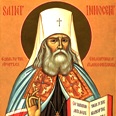
by St. Innocent of Alaska

Our father among the saints Innocent of Alaska, Equal-to-the-Apostles and Enlightener of North America (1797-1879), was a Russian Orthodox priest, bishop, archbishop, and Metropolitan of Moscow and all Russia. He is known for his missionary work, scholarship, and leadership in Alaska and the Russian Far East during the 1800s. He is known for his great zeal for his work as well as his great abilities as a scholar, linguist, and administrator.
He was a missionary, later a bishop and archbishop in Alaska and the Russian Far East. He learned several native languages and was the author of many of the earliest scholarly works about the natives and their languages, as well as dictionaries and religious works in these languages. He also translated parts of the Bible into several native languages. His translations are still considered the authoritative translations in native Alaskan language studies to this day.
What is Confession? Confession is the oral avowal of one’s sins which lie heavy upon the conscience. Repentance cleanses the soul and makes it ready to receive the Holy Spirit, but confession, so to speak, only empties the soul of sins.
Let us present a simple analogy and comparison to confession. For example, suppose you had only one vessel of some kind, which you through negligence or laziness let reach a stage where little by little it accumulated all sorts of dirt so that your vessel became not only unusable but even unbearable to look at without repugnance. But what if a king wanted to give you as a gift some sort of fragrant and precious balm, one drop of which could heal all infirmities and protect what then?
Would you refuse such a valuable gift only because you had no other clean vessel in which to put it? Read more
Concerning Thoughts
February 27, 2010 by: admin
Filed under: Patristics
An Excerpt from Exomologetarion (A Manual of Confession)
by St. Nikodemos the Hagiorite
Our venerable and God-bearing Father, Nicodemus of the Holy Mountain (or Nikodemos the Hagiorite) was a great theologian and teacher of the Orthodox Church, reviver of hesychasm, canonist, hagiologist, and writer of liturgical poetry. St. Nicodemus reposed in the Lord in 1809 and was glorified by the Orthodox Church in 1955. He is a local saint of the Metropolis of Paronaxia and the Holy Mountain. His feast day is celebrated on July 14.
Just as so-called diagnostic physicians not only know how to treat external and visible wounds of the body, but also, by measuring the pulse, they learn the internal and invisible maladies of the heart, of the bowels, and the other unseen workings of the human body, and are therefore able to treat them.
Likewise, Spiritual Father, it is not enough for you only to know how to treat the external passions of the soul, those acts and deeds and effects of sin, but it is also necessary to know through the confession of the penitent the internal wounds of his soul, which are the hidden passions in his heart and the passionate and evil thoughts, and so treat them with great scrutiny and care. Read more
Why Should I Confess My Sins To A Priest
February 26, 2010 by: admin
Filed under: Sermon Resources
by Fr. John Dresko
A priest of the Orthodox Church in America, Fr. John first published this excellent little article in March 1995.
Great Lent is now upon us. It is a time for what Fr. Alexander Schmemann (of blessed memory) called “bright sadness.”
It is a time, above all, for reflection and movement back to God.
Sin, in literal translation, means “missing the mark.” Not being where we should be. Where we should be, but are not, is in communion with God. So, for practical purposes, sin is separation from God. And, by definition, separation from God is death–because life can only exist where God is present. Read more
A Catechism on Confession
February 26, 2010 by: admin
Filed under: Sermon Resources
As each of us clergy/preachers prepares not only for our own confession, but to exhort and encourage the repentance and confession of our flock, I thought this article would start off a series on Confession nicely. This was originally published in the publication “The Shepherd” published by the Brotherhood of St. Edward the Martyr, London, England.
When preparing to go to confession, every Orthodox Christian should try to remember all the sins that he has committed, whether voluntary or involuntary, and should examine his life in detail. If there are sins that were committed before his last confession, but which he then forgot to confess, he should mention these also.
When you come to confession, you should confess your sins sincerely, remembering that you are not confessing them to the priest, but to God Himself, Who already knows, but wants you to admit your wrongs and your guilt. You should not feel embarrassed before your spiritual father, because, being a man like yourself, he knows human weaknesses and the inclination that all people have towards sin, and thus he cannot judge you harshly when you come to confession. But maybe you are embarrassed to confess your sins before your spiritual father because you are afraid of losing his good opinion? Read more
On The Homilies of St. Gregory Palamas
February 26, 2010 by: admin
Filed under: Sermon Resources
by Metrpolitan Hierotheos Vlachos

His Eminence Metropolitan Hierotheos (Vlachos) of Nafpaktos serves the Metropolis of Nafpaktos in the Church of Greece. His study of the patristic texts and particularly those of the hesychast Fathers of the Philokalia, many years of studying St. Gregory Palamas, association with the monks of the Holy Mountain (Mount Athos), and many years of pastoral experience, all brought him to the realization that Orthodox theology is a science of the healing of man and that the neptic fathers can help the modern restless man who is disturbed by many internal and existential problems. In his books, he conveys the Orthodox spirit of the Philokalia to the restless and disturbed man of our time. This is why they have aroused so much interest.
This is an excerpt from his book “St. Gregory Palamas as a Hagiorite.”
Apart from the polemical writings which have survived, there are also homilies by St. Gregory which show that he expresses the hesychastic life of the Holy Mountain. Some of these were addressed to the monks on the Holy Mountain on various feast days, and the rest were spoken to his Flock in Thessaloniki. It is characteristic that in speaking to his Christians, he teaches noetic prayer and thus shows that there is not a great contrast between monastic life and married life. From the abundance of passages which St. Gregory interprets hesychastically I would like to select four in particular. Read more
Palamas: The Dispute With Barlaam
February 25, 2010 by: admin
Filed under: Sermon Resources
by Metrpolitan Hierotheos Vlachos

His Eminence Metropolitan Hierotheos (Vlachos) of Nafpaktos serves the Metropolis of Nafpaktos in the Church of Greece. His study of the patristic texts and particularly those of the hesychast Fathers of the Philokalia, many years of studying St. Gregory Palamas, association with the monks of the Holy Mountain (Mount Athos), and many years of pastoral experience, all brought him to the realization that Orthodox theology is a science of the healing of man and that the neptic fathers can help the modern restless man who is disturbed by many internal and existential problems. In his books, he conveys the Orthodox spirit of the Philokalia to the restless and disturbed man of our time. This is why they have aroused so much interest.
This is an excerpt from his book “St. Gregory Palamas as a Hagiorite.”
His “dispute” with Barlaam
It was with difficulty that the saint began this “dispute”, because he did not wish to abandon the stillness of his life on the Holy Mountain. But when he was asked by his spiritual brothers, and when he himself realised that the faith was in danger of being altered, which would also have resulted in altering the means of man’s cure, of losing the way of salvation, then he began his struggle.
At first he did it with great humility and discretion. He finished one of his letters to Barlaam by saying that in spite of the reproach that he felt against Barlaam for his erroneous ideas on serious theological questions, he still maintained the same love for him. He called him a very wise man, the best of those who loved and were loved, and he emphasised that in spite of the dispute, the state of peace would be maintained. At the same time he expressed the desire that they should meet to embrace with a holy kiss. Read more
Theosis: Union with God
February 24, 2010 by: admin
Filed under: Sermon Resources
by Metropolitan Hierotheos Vlachos
His Eminence Metropolitan Hierotheos (Vlachos) of Nafpaktos serves the Metropolis of Nafpaktos in the Church of Greece. His study of the patristic texts and particularly those of the hesychast Fathers of the Philokalia, many years of studying St. Gregory Palamas, association with the monks of the Holy Mountain (Mount Athos), and many years of pastoral experience, all brought him to the realization that Orthodox theology is a science of the healing of man and that the neptic fathers can help the modern restless man who is disturbed by many internal and existential problems. In his books, he conveys the Orthodox spirit of the Philokalia to the restless and disturbed man of our time. This is why they have aroused so much interest.
This is an excerpt from his book “St. Gregory Palamas as a Hagiorite.”
However, in saying that St. Gregory is one who expresses the hesychastic life of the Holy Mountain, we must examine just what hesychia is according to the orthodox teaching.
Hesychia, stillness, is essential for man’s purification and perfection, which means his salvation. St. Gregory the Theologian says epigrammatically:
“One must be still in order to have clear converse with God and to bring the nous a little away from those wandering in error”
Through hesychia a man purifies his heart and nous from passions and thus attains communion and union with God. This communion with God, precisely because it is man’s union with God, also constitutes man’s salvation. Read more
Many Confess, Few Repent
February 23, 2010 by: admin
Filed under: Featured, Sermon Resources
This article is an excerpt taken from the book titled “REPENTANCE AND CONFESSION”, by Monk Moses of the Holy Mountain, “Orthodoxi Kypseli” Publications, Thessaloniki.
I am indebted to Fr. John Stavropoulos for bringing it to my attention.
Confession is a God-given commandment, and it is one of the Sacraments of our Church. Confession is not a formal, habitual (“to be on the safe side”, or, “in view of upcoming feast-days”), forced and unprepared act, springing from an isolated duty or obligation and for psychological relief only. Confession should always be combined with repentance. A Holy Mountain Elder used to say:
“Many confess, but few repent!”
(Elder Aemilianos of the Simonopetra Monastery, Mt. Athos)
Repentance is a freely-willed, internally cultivated process of contrition and sorrow for having distanced ourselves from God through sin. True repentance has nothing to do with intolerable pain, excessive sorrow and relentless guilty feelings. Read more
Knowledge of God according to Palamas
February 23, 2010 by: admin
Filed under: Sermon Resources
by Metropolitan Hierotheos Vlachos

His Eminence Metropolitan Hierotheos (Vlachos) of Nafpaktos serves the Metropolis of Nafpaktos in the Church of Greece. His study of the patristic texts and particularly those of the hesychast Fathers of the Philokalia, many years of studying St. Gregory Palamas, association with the monks of the Holy Mountain (Mount Athos), and many years of pastoral experience, all brought him to the realization that Orthodox theology is a science of the healing of man and that the neptic fathers can help the modern restless man who is disturbed by many internal and existential problems. In his books, he conveys the Orthodox spirit of the Philokalia to the restless and disturbed man of our time. This is why they have aroused so much interest.
This is an excerpt from his book “Orthodox Psychotherapy.”
We must pray fervently for God to grant us to reach this knowledge of God. The exhortation is clear:
Come, let us ascend into the mountain of the Lord, even to the house of our God, and behold the glory of His transfiguration, glory of the Only-begotten of the Father. Let us receive light from His light, and with uplifted spirits let us for ever sing the praises of the consubstantial Trinity. Read more